I was recently asked, "Annie, is it possible for these foreign students, who do not speak a word of the local language to live in this community and manage to communicate with people?" I honestly believe that half of communication is just being mentally and physically present. Anyone can do this, but few put conscious effort into it. Am I really here? Do the people around me really feel like I am 100% here? In an age of multi-tasking, we are used to stretching ourselves across different times, places or responsibilities. Sometimes the hardest part is to just be. You share a lot in common with someone when you are physically present, sitting with them, eye to eye, without saying anything. Maybe the words around you make no sense, but you are there, and this is half the battle.
I was at a birthday party. I love celebrations, but at this point in my life I dreaded the large gatherings because I had a hard time following a fast conversation. I kept turning my head right and left, trying to look at the ladies who were speaking, trying my best to piece together words in the hopes of understanding what they thought was so funny. While they were laughing, my eyebrows moved towards each other as if a scowl could help me comprehend this new language. One of the ladies noticed that I was the only one not laughing, patted my leg and said slowly and definitely, "Annie, you will soon understand. You are here. Listen and you will laugh with us soon." So, I continued to attend the birthday, wedding and baby parties, looking forward to the day when I would laugh at the jokes and chime in with my own. About six months later I was attending another birthday party and I had my "ah-ha" breakthrough moment. The ladies were laughing again and this time I understood.
"The other day I saw the funniest thing," the story began, "two cows were running down the street with their ropes broken. I knew the cows belonged to our neighbor..."
And then I understood where the story was going. The week before I was in the banya doing my laundry when my host-family's cows broke free from their ropes and ran out into the street. I immediately threw on my dress and ran out into the street without shoes or a headscarf over my hair. I was yelling at the cows in English, cursing under my breath as I realized that all the neighbors had come out to watch me try to herd the cattle.
"And instead of Rahat, guess who runs out onto the street? Annie! Annie was running around without shoes, up and down the street, yelling Masha, Dasha at the cows. Cows don't know their names!"
As the women around me started to giggle, I could feel my face turn hot and red. I understood the story, and now I was aware that everyone was laughing at me. What progress!
"But," the storyteller interjected. "She caught the two cows as they were eating Baygul's flowers and led them home. See, she understands our language, and she can catch our cows!"
The lady sitting next to me turned to me and said, "You are now Turkmen and you can never go home to America because you don't have cows there!" With that everyone, including me, laughed. They laughed at this new Turkmen Annie, and I laughed at the absurdity of thinking we don't have cows in Idaho!
If you take it a step at a time, focusing on where you are right now, at home or far, far away, your energy and presence speaks for itself. This aspect of communication is cross cultural and transcendent. Don't be too hard on yourself if you struggle in the present, because with time communication becomes easier and the bridges of cultural, linguistic and philosophical differences can be crossed, even if they think cows don't exist in America.
Saturday, October 29, 2011


Thursday, September 29, 2011
Baclayan Basket Project

This project is what has kept me busy for the last three months, and what will continue to bring me back to the Philippines for many more years to come. I wrote this article on the project's developments for Stairway Foundation, the sponsoring organization.
For years now, Stairway Foundation (SFI) has been reaching out to the local indigenous Iraya Mangyan in an effort to help uplift the community from poverty. In 2009, SFI purchased some land in one of the local Iraya communities called Baclayan. During the time of purchase, we observed a community that was struggling on many levels. Because of this, Stairway Foundation has since started several community development to partner with the community in creating positive and sustainable change, especially for the young generation, the children.
 Stairway Foundation volunteers recently jumpstarted a long-term project in Baclayan that focuses on working with the local basket weavers. Basket weaving has been a part of Iraya Mangyan culture for many generations. Traditionally, girls learn to weave baskets when they are 7-8 years old, beginning with simple pieces and working their way up to complicated designs. Both men and women know how to weave baskets, but it is more common for women to use basket selling as a means of livelihood. For many years, Stairway Foundation has invited the women of Baclayan to come to SFI to sell their baskets every week. SFI has become one of the most consistent purchasers of baskets in the community, but the Foundation was looking for a more in depth way to work with the Iraya women to help them learn practical business and marketing skills in order to more successfully sell their baskets at large.
The first goal of the project is to create a community of empowered women who possess self-esteem and a desire to change their community. Volunteers conducted several life-skills sessions in the hopes of identifying local women leaders, who can become future life-skills trainers. There was a noticeable change in the women, a “sparkle,” as one person described it. They became more outspoken, gregarious and assertive. They displayed a keen desire to learn more about smart marketing practices, and to use their creativity to create new products to give them an edge in the market. They took great pride in the new knowledge and skills that they were acquiring, and have expressed an interest in teaching more local women what they have learned.

The second goal of the project is to have a community of women who have the capacity to successfully market their baskets. A volunteer facilitated sessions on product diversification, organizational skills, and marketing strategy, with the long-term goal of capacitating the women with the ability to market and sell their baskets domestically and internationally by themselves.
One very exciting development that happened was the creation of new product—hand-woven earrings. By using their creativity and innovation, the women designed several styles of earrings, from hoops to circular spirals. The women attended a short training on attaching the metal earring hooks and rings, and soon were producing large quantities of beautiful earrings. All of the earrings were quickly bought by customers, amazed by the craftsmanship and detailing.
 In order to start labeling their products, the women learned how to create tags for the baskets. They first attended a training to learn how to make hand-made paper from banana stem fibers and indigenous cogon grass. While perfecting their paper-making skills, they participated in the design stage of a tag, creating a label that features a photograph of an Iraya woman and the story behind the basket.
Although this project is very long-term, and will hopefully develop for many years to come, it is off to a successful start and has already generated positive feedback from the women. Stairway Foundation is dedicated to working closely with these talented artisans, capacitating them with valuable skills and knowledge, thereby putting them in a more empowered position to stand up for their rights as women and as Indigenous Peoples.
My Summer Months

I was so busy in the Philippines with work and playing at the beach, that I did not have time to update my blog. What began as a two-month committment extended to a six-month period of volunteer work at Stairway Foundation, Inc. Despite not writing on my blog, I was busy writing several pieces for the Stairway Foundation website.
Stairway Foundation has a residential program for former street kids from Manila. I had the opportunity to care for one of the Stairway boys after jaw surgery. Having gone through jaw surgery myself, I was eager to help him in any way I could post-operation. The following is the story that I wrote about this incredible little boy:
"A New Smile, a New Voice, a New Taste"

A big part of my summer was working with Stairway Foundation's local scholarship students. Click here for a description of the program that I wrote for the website. I was in charge of preparing a curriculum of tutorial sessions for students struggling in English and Math. I taught several groups of students in different municipalities. At the end of the summer, we invited 25 of the most motivated and active scholarship students to attend a leadership camp entitled, "My Right to be a Leader." The following is the article that I wrote about the summer camp experience:
"We Should Not Judge Other People, and Discriminate Them." -Stairway Scholar

Stairway Foundation is located in Puerto Galera, Oriental Mindoro. The property faces the ocean and backs up against the mountains that rise straight from the sea. It is a place of not only beauty, but serenity and acceptance. Life sometimes takes you exactly where you need to go, even if you don't know it yourself. I learned this lesson when I stumbled upon Stairway completely by chance, not knowing what I was getting myself into, and found a truly magical place where I could connect with people, learn a lot about myself and dive into work that is extremely meaningful to me. I hope that everyone has the opportunity to stumble upon their own oasis.
Sunday, February 6, 2011
The Year of the Rabbit
In my opinion, the monkey, ox, rooster or rat can't beat the rabbit in cuteness or cuddliness! After the ferocious year of the Tiger, 2011 will be more quiet, reflective and possibly more tame. I personally could use an uneventful year. In Chinese mythology the rabbit represents longevity and is thought to derive its power from the moon. The rabbit symbolizes graciousness, kindness, good manners and a sensitivity to beauty. Although the rabbit may seem timid and overly deliberate at times, the rabbit is very self-assured and occasionally conceited. But this rabbit doesn't look so narcissistic...

This year is my first Chinese New Year in Taiwan. I love holidays, and I love learning about holiday customs in new countries. I believe that one can learn so much about a culture from paying close attention to holiday traditions.
The Chinese New Year preparations began well ahead of time, as people shopped in Di-Hua Street, a narrow side street converted into the central lunar new year shopping area.
檢視較大的地圖
All of the specialty foods enjoyed during the New Year are sold in jam packed stalls below fluttering lanterns and lights. In the days leading up to the New Year, Di-Hua Street is so crowded that one cannot fight the crowd, but must be pulled along in all directions up the road. It is a frantic mix of smells, sounds, hip-hop dancing vendors, samples in tiny cups, and excited people. Bags of snacks, fruit and gifts are brought home, distributed among friends and family and enjoyed over the holiday.
Being a neophyte, I was anxiously waiting around on New Year's Eve for something 'holiday like' to happen. As the sun set, food was prepared and set in front of the Buddhist alter as an offering to the ancestors. For our own dinner, we enjoyed various dishes eaten in the traditional communal way, when everyone takes some from one plate. After our meal, more dishes were prepared and set out on a table near the window. This offering of food, fruit, flowers, desserts and money was set out for the Gods.

Incense were lit at 11:15pm when the New Year begins according to the Lunar Calendar. When the incense were half way burnt, we went down onto the street to burn the paper money as an offering to the Gods.

In a metal container, we folded the money and set it on fire piece by piece.

When we were back inside, the bang and crack of fireworks had already begun. According to a Chinese myth, the New Year Monster does not like the color red or the sound of fireworks. In order to scare off the monster, people hang bright red decorations on their houses and light off fireworks during the week of celebration. For the last four days there has been a constant bang of fireworks as everyone plays their part in scaring away the monster.
Because everyone is enjoying a week of vacation, shops, restaurants and businesses are closed, and there is a general feeling of relaxation. People are at home with their families, enjoying this rare time together. On Tuesday everything will open again, and the quiet streets of Taipei will transform back into the thriving metropolis that it was before the New Year holiday.

This year is my first Chinese New Year in Taiwan. I love holidays, and I love learning about holiday customs in new countries. I believe that one can learn so much about a culture from paying close attention to holiday traditions.
The Chinese New Year preparations began well ahead of time, as people shopped in Di-Hua Street, a narrow side street converted into the central lunar new year shopping area.
檢視較大的地圖
All of the specialty foods enjoyed during the New Year are sold in jam packed stalls below fluttering lanterns and lights. In the days leading up to the New Year, Di-Hua Street is so crowded that one cannot fight the crowd, but must be pulled along in all directions up the road. It is a frantic mix of smells, sounds, hip-hop dancing vendors, samples in tiny cups, and excited people. Bags of snacks, fruit and gifts are brought home, distributed among friends and family and enjoyed over the holiday.
Being a neophyte, I was anxiously waiting around on New Year's Eve for something 'holiday like' to happen. As the sun set, food was prepared and set in front of the Buddhist alter as an offering to the ancestors. For our own dinner, we enjoyed various dishes eaten in the traditional communal way, when everyone takes some from one plate. After our meal, more dishes were prepared and set out on a table near the window. This offering of food, fruit, flowers, desserts and money was set out for the Gods.

Incense were lit at 11:15pm when the New Year begins according to the Lunar Calendar. When the incense were half way burnt, we went down onto the street to burn the paper money as an offering to the Gods.

In a metal container, we folded the money and set it on fire piece by piece.

When we were back inside, the bang and crack of fireworks had already begun. According to a Chinese myth, the New Year Monster does not like the color red or the sound of fireworks. In order to scare off the monster, people hang bright red decorations on their houses and light off fireworks during the week of celebration. For the last four days there has been a constant bang of fireworks as everyone plays their part in scaring away the monster.
Because everyone is enjoying a week of vacation, shops, restaurants and businesses are closed, and there is a general feeling of relaxation. People are at home with their families, enjoying this rare time together. On Tuesday everything will open again, and the quiet streets of Taipei will transform back into the thriving metropolis that it was before the New Year holiday.


Monday, December 27, 2010
Running With Chihuahuas
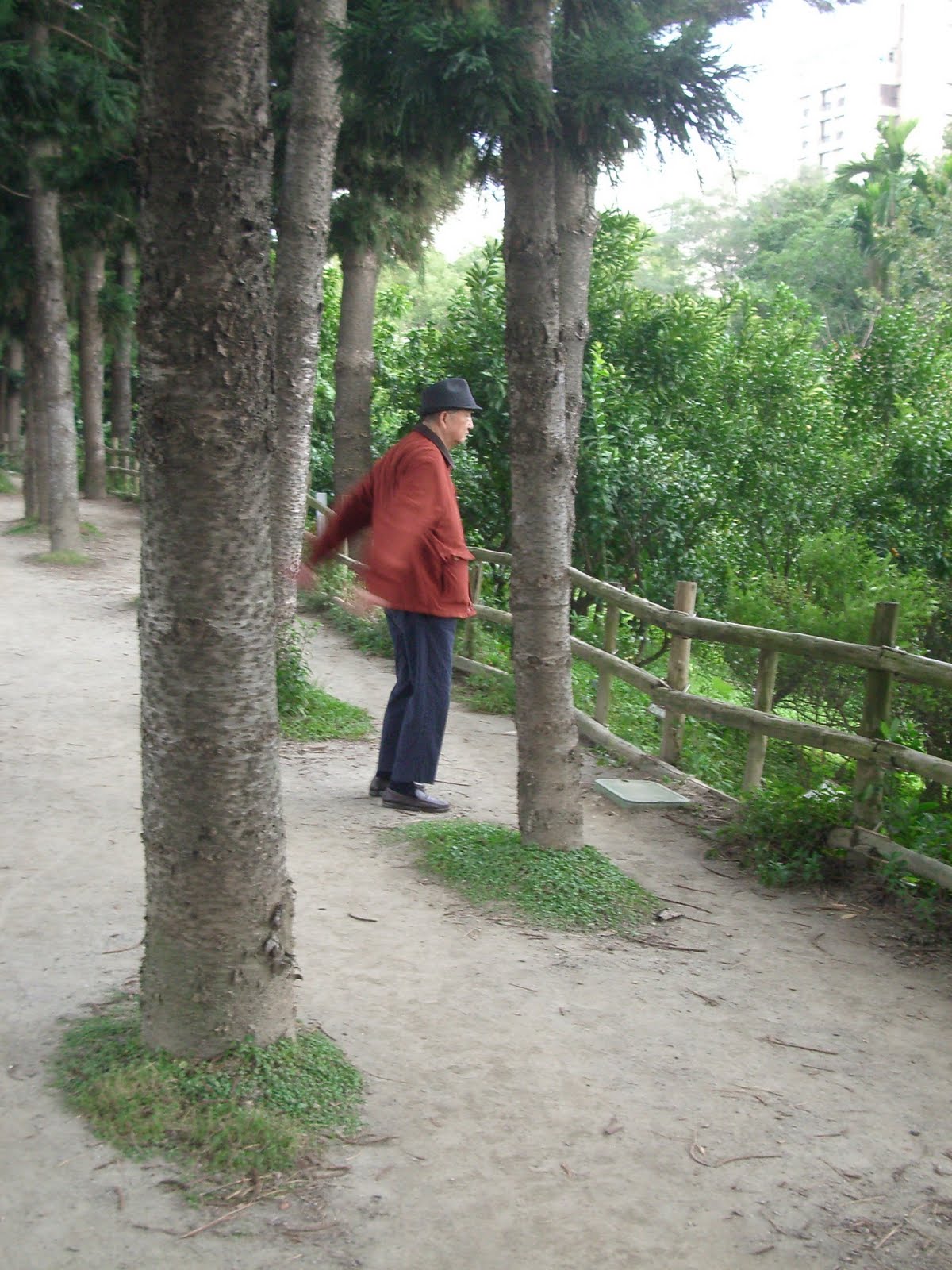
Going running for the first time in a new country is always an unpredictable experience. I love heading out the door not knowing where I am going or where I am going to end up, but often a tall Caucasian girl running by herself attracts the wrong kind of attention or invasive curiosity from everyone passing by. Because it is so common for women to run in America, we tend to take the relative anonymity we have while exercising for granted. Despite the obesity problem in America, and the attention that it placed on our expanding girth, many Americans enjoy exercising and playing sports in their free time. There is a growing importance placed on staying fit and eating healthy, and this is reflected in the increasing amount of Americans who are exercising. The Centers for Disease Control and Prevention reported that 35% of adults engage regularly in leisure-time physical activity, according to a nationwide survey done in 2009. This statistic was higher than the 2008 estimate of 32%. Yet obesity continues to plague America because exercise can only burn so many calories. Maintaining an all around healthy lifestyle is what Americans need to work on; eating better is crucial. I have always lived in areas in America where I could easily exercise, and in particular run. I took up running regularly because it seemed like the most convenient sport for someone who constantly moves around the world. When the stress of a new environment is wearing me down, I can always lace up my shoes and get lost in the hypnotic rhythm of my sneakers hitting the ground. But often running in a new place isn’t as straight-forward as running along a familiar trail back home.
When I lived in Costa Rica and tried to run along the jungle-enclosed street where my house was, I was stopped by one of the local drug gangs and prohibited from continuing along their road. In Russia I couldn’t stand all of the snide comments and soon resorted to working out in a local gym. In Turkmenistan I ran in a skirt and carried rocks to throw at the overly aggressive dogs in my town. The last three countries in which I lived all offered different challenges when it came to stepping out the door for a run.

In these I received a huge amount of attention from people around me and I tried my best to run in places and at times when I hopefully wouldn’t see anyone. My initial mistakes cautioned me, and taught me what was appropriate in the local culture. I would run in the dark, or run out of town, away from everyone. This didn’t ever completely stop the harassment I received, but it minimized it down to a point when I could get back to focusing on the rhythm of my feet and the sound of my breathing. I believe that the level of harassment I receive while running is in direct correlation to the level of women’s rights in the country. In countries where women are not allowed to exercise in public, or where it is highly frowned upon by the men, I have received the highest level of negative attention. In Turkmenistan there were a few women I saw who defied the social norm and ran in public. This was more common in the city, and in the countryside where I lived, a few women in my town started running in the mornings along the same path I took. When I first saw this young woman out jogging in her pale blue tracksuit, I broke into the biggest smile because I finally had another companion out on the road. Running in Turkmenistan was a lonely business, and when I moved to Taiwan I was excited to lace up my shoes and see what I ran into in Taipei.
If one wakes up early enough in Taiwan one can see groups of people in parks practicing Tai Chi, or speed walking around the local track. As the sun sets, another round of people will go out and exercise at dusk. There are lots of people, young and old, who enjoy walking outside. I see grandparents running up and down the track with toddlers, couples wheeling an elderly grandparent along the bike path, marathoners running in sweat soaked shirts. According to the National Council on Physical Fitness and Sport, “scientific research testifies that proper sport activities are beneficial to physical fitness…and contribute to a higher living standard, social harmony…” and there is a general understanding in Taiwan that physical activity is beneficial to overall health and lifestyle.
In rain or shine people are out and about. When it rains I see people jogging around the track holding an umbrella above them, an answer to my rain predicament question I had not yet considered. When it is sunny I put on less clothing in order to soak up the sun, and the locals wear long sleeve shirts to protect against tanning of any degree.
When I run in Taiwan I still get stared at, but the attention holds much less hostility than in other countries. It is not unheard of to see a woman running, and so I will often receive a glance but not much attention after that. I am and will remain the only Caucasian girl running in the neighborhood where I live, but there are other women who exercise and this is welcome company for me after my negative experience in Turkmenistan. I still feel a little silly in my running outfit and Ipod as I make my way to where I begin running because I stand out so much, but once I get to the running track or the bike path then there seems to be a general understanding of “this space is for exercising, so even that white girl running is normal.”
The bike path runs along the Keelung river embankment as it winds its way from the ocean down toward Taipei. I like to glance down at the water to find the dense schools of fish along the banks, hiding in the deepest parts of the river. There are two cows that are always happily chewing grass along the banks below me, and I occasionally meet the farmer along the bike path as he leads them to graze. Because of being wary of an animal’s reaction to a running human, I tend to slow down around the cows and this always causes the farmer to erupt in laughter and ask me questions I don’t understand.

Sometimes I am more entertained by the parade of dogs, than by the people I see along the way. Taiwanese women are always out walking their miniature dogs. Often the dogs don’t get much of a walk themselves because they are being pushed in a doggie stroller, leaning out the side with their tails wagging and tongues hanging out. I wonder if the women pushing the stroller realize that they have a dog in there and not a child. The other day a woman was weeding some flowers along the path, and her little Chihuahua decided to race over to me and try biting my ankles. I resorted to hopping around in order not to kick the little thing in the face, but the worst part about it was that the dog was wearing a bumblebee costume. And again, the owner responded to my reaction with a shrill of laughter and a slur of Chinese words. The most I could do was shoot the Chihuahua in its bumblebee costume a dirty look, and run away faster than its little legs could carry it.

Now I have a set route that I take when I run, but occasions like the Chihuahua attack still catch me by surprise and prevent my runs from ever being boring. I don’t want to carry around rocks to throw at the dogs like in Turkmenistan, because it is only the tiny ones who consider my ankles nice enough to bite, but I will never again underestimate a four-pound dog in a plush insect costume.
Sunday, December 12, 2010
Human Rights Day: LGBT Rights in Taiwan

December 10th was the 60th Anniversary of Human Rights Day. The theme for this year is “human rights defenders who act to end discrimination.” Human rights defenders speak out against human rights abuses and violations, often taking risks themselves in order to raise awareness and create change. I recently had a Taiwanese acquaintance tell me that he thought Taiwanese did not care about human rights. I have to disagree with him.
Since arriving in Taiwan, I have been introduced to a unique and dedicated group of human rights defenders. They do the work of hundreds by mobilizing the general population, organizing volunteers and putting together large events and human rights demonstrations. From what I have seen, these Taiwanese do care about human rights. More than just caring, they are fervently passionate about human rights.

During my first weekend in Taiwan, I was invited to march in the annual Taiwan Pride Parade. I have been to several pride parades in America, including New York’s epic parade, and I was not sure what to expect in Taipei. The first parade was held in 2003, and it was the first of its kind in the Chinese-speaking community. It was a small event, but it drew big attention from the local and international media. Taipei’s Mayor, and current president, Ma Ying-jeou, gave a speech at the end of the parade, saying that major cities around the world have large gay communities, and that the support and respect of these communities is important to the city. Since 2003, the number of participants and support for the event has grown each year.


Taiwan is the most progressive Asian country in terms of anti-discrimination laws protecting lesbian, gay, bisexual and transgender (LGBT) rights. In 2007 the Legislative Yuan passed a law banning discrimination based on sexual orientation in the work place. The Gender Equity Education Act prohibits discrimination in education, and beginning in 2011, school textbooks are required to include topics on LGBT human rights and non-discrimination. Taiwan’s Ministry of Education is hoping to promote an environment of tolerance and respect. A poll done by the National Union of Taiwan Women’s Association/Constitutional Reform Alliance in 2006 found that 75% of the 6,439 adults interviewed believed that homosexual relations are acceptable.


Despite having some legislation in place to stop discrimination, there is little written in law to give the country’s LGBT citizens the same rights as their heterosexual counterparts. “The concept of ‘partner’ does not exist in Taiwan,” Lu Hsin-chieh, convener-in-chief of the march, and director of policy advocacy at Taiwan Tongzhi Hotline Association said. “Taiwan’s Civil Code defines a couple as ‘a husband and a wife.” The Basic Human Rights Law, which approved same-sex marriage, was drafted during former president Chen Shui-bian’s term, but has never been voted on due to opposition from cabinet members and legislators. This year three openly gay candidates ran in Taipei City’s legislative elections, and this new presence in local politics coincided with this year’s parade theme.
Taiwan Gay Pride - no comment
Uploaded by nocommenttv. - Up-to-the minute news videos.
On October 30th, the pride parade theme was “Out and Vote,” an attempt to focus on getting concrete legislation passed by the government in order to protect LGBT rights in Taiwan. Everyone congregated in front of the President’s Office, filling up the large square and spilling over into the nearby streets. Clusters of brightly clad men and women met at the closest metro stations to walk together, and drag queens paraded around striking poses and blowing kisses. Participating groups were split up into colors: red, orange, yellow, green, blue and purple. As the parade snaked around the city, sharing the streets with cars, buses and motor scooters, at times it was hard to distinguish between the parade participants, spectators and people passing by. Every person along the sidewalk was filming the parade on a camera phone, either out of support or sheer curiosity about what was marching down the street. When people in our group waved to passing cars and buses, we received blank stares or big smiles in return. The weather could not decide to rain or stop, and this left us continually putting up our umbrellas and pulling them down as we walked. Because we were sharing the road with the usual traffic, we had to stop at red lights and then make a run for it when they turned green in order to catch up to the group in front of us. I heard one guy behind me say, “I didn’t know this was the gay marathon,” as we sprinted through an intersection. At the end of the march, all of the color sections lined up in a pseudo rainbow to get a panorama shot of the entire group from atop a nearby building. Looking at the picture later on the Taiwan LGBT Parade website, I could feel the enormity of over 30,000 people and the giant voice of a group of people united by one cause.

Despite only having one day out of the year designated the official Human Rights Day, in many peoples’ lives human rights is a constant priority. LGBT rights is a relatively new fight in Asia, and I believe that Taipei is going to continue to be the leader in this struggle against discrimination.
External Links:
Taiwan Pride Parade Slideshow
United Nations Human Rights Day Website
Thursday, December 9, 2010
Cultural Differences: Part Two

Last week I went to a cupcake shop called “Ginjer” and I enjoyed a carrot cake cupcake complete with a little icing carrot on top. Across the street in this back alley was a number of restaurants, each one offering a different type of cuisine. There was Japanese, Korean, Italian and Cantonese food. Tucked into the tiniest crevices were Taiwanese street food stands—noodles, soup, dumplings and rice balls.
Taiwanese love food, and they like to enjoy different kinds of culinary delights. I am used to living in a place where there is limited availability of international foods. It is so exciting to be living in a place with restaurants every ten feet offering a broad selection of cuisine. There is fast food and traditional food. There is fancy dining and plastic bag carrying night market food. There is 7-11 on every corner for all of your snacking needs. There are chain style ubiquitous restaurants and cute vintage themed coffee shops and stylish modern cafes. Taiwanese are relatively adventurous when it comes to trying new food; otherwise, the abundance of international cuisine restaurants would not be in business. I have experienced plenty of places where people turn up their noses at anything unfamiliar. I find Taiwanese quite tolerant of new tastes, and willing to try anything once.
In Turkmenistan there were about five national dishes that were made of the same ingredients—meat, carrots, potatoes, rice and pumpkin. There was little left to the imagination. I taught my students how to make pizza and pumpkin pie. I taught my closest Turkmen friend how to make Thai peanut noodles and rich chocolate brownies. Some Turkmen I met loved to learn how to cook new dishes, but most sided with familiarity. In Taiwan I recently cooked spicy Mexican tacos complete with tortilla chips and salsa. Taiwanese love spicy foods, so this dish went over well.
Being new to the country, I need the same outlook as my Taiwanese counterparts—try anything once! In a country where the smell of stinky tofu wafts on countless street corners, there are many adventurous dishes to be sampled.

One of the most famous dishes in Taiwan is the aforementioned stinky tofu. I have heard many colorful descriptions of the smell of this dish. It has acquired the name stinky tofu because it is exactly that—very, very stinky. It used to be a staple for soldiers patrolling China’s borders, and as wars ended and Taiwan’s night market culture expanded so did the availability of stinky tofu on the street. It is made by marinating tofu in a brine made from fermented vegetables, shrimp or fish stock. The fermentation process of the vegetables or fish can take up to 5 months, but marinating requires only 6 hours. Taiwan has a famous stinky tofu eatery, Dai’s House of Stinky Tofu, which is famous for its vegetarian version. Once the tofu is marinated, it is cut into bite-size pieces and most commonly deep-fried. This is a dish that either intrigues you or repulses you. Taiwanese will admit that it doesn’t smell good, but they will try to convince you to sit down and take a bite. And you should try it!

I have tried stinky tofu a few times, but it does not make my favorites list. As for me, I love bubble milk tea, and specifically bubble tea from the “50 Lan” shop. I enjoy a large cup...half sugar...less ice...big bubbles...to go...phew! A lot of details for one cup of tea. I had to learn lots of vocabulary just to get the right cup of bubbly, chewy satisfaction. The teashop attendants pile soft, sweetened tapioca bubbles into the bottom of the cup and shake up milky tea and ice in a cocktail mixer. They pour the milk tea over the bubbles and drop in a little ice. The cup is dropped in a machine that seals a thin plastic top onto the cup. They give you a fat straw wide enough for the tapioca, and you have to poke the straw through the plastic top to enjoy that first sip of sweet tea and chewy tapioca. Bubble tea has become so popular that the fad spread all the way to America where a popular Taiwanese teashop started a branch in California. There are many bubble teashops to chose from here, but I am very loyal to “50 Lan.” The bubbles are always soaked and cooked perfectly, and they use rich milk that makes the taste of the tea really stand out. Maybe I end up over analyzing my cup of bubble tea, but when it comes down to it, the idea of mixing chewy tapioca into a traditional cup of tea is an example of the quirky and adventurous taste buds that Taiwanese have. They combine tastes and aren’t scared to incorporate different textures, which is what makes Taiwanese street food so interesting for me.
Wednesday, December 8, 2010
Cultural Differences: Part One

Lately I have been thinking about cultural differences. I am not talking about cultural differences between America and Taiwan, but cultural differences between Turkmenistan and Taiwan. And I have been thinking about how living in one country can greatly affect your experience in the next. I am more prone to notice and appreciate certain things about Taiwanese culture that I may have overlooked before. Living in Turkmenistan for almost two years in an extremely isolated and politically rigid environment left me hyper sensitive to the lack of restrictions and autonomy that Taiwanese (and I) have here.

On November 27th was a special municipality election for mayors and city councilors in Taiwan. Five cities in Taiwan voted for mayors and local representatives. The streets of Taipei were lined with flags from all the different candidates and huge banners covered bridges and buildings. In the last few weeks leading up to the election, it was commonplace to see a candidate riding around in an open-air car waving to everyone on the street. There was a last minute break in social order when the son of former vice-president, a supporter of a Taipei councilor candidate, was shot while on stage at a rally the evening before the election. Political parties pointed fingers at each other, but there was little conclusive evidence compiled in the few hours before the voting booths opened.

There are two main parties in Taiwan, the Chinese Nationalist Party (KMT), the more conservative, pro-China party, and the Democratic Progressive Party (DPP), the pro-independence party. There is a Green Party as well that is a much more serious contender in the elections than the Green Party in America. Taiwanese do not need to register to vote, but are eligible to vote at the location closest to their address on their national identification card. Voters need to bring their national identification card and their personal stamp that has their name carved into it. I peered into a voting booth that was situated in a tiny Japanese style building in a narrow alley at the base of the mountains in Nangang. Voters had their identification verified and were handed the ballots. They took the ballots into the voting box and stamped what looks like a peace sign missing one of the downward pointing lines next to the candidate they are voting for. Voters dropped the ballots into color-coded boxes and exited out of a different door. The weather was bright and warm, and less voters stopped their sunny day activities to go to the voting booth than if the weather had been rainy. Yet, despite the lower turnout of voters than previously recorded, about 70% of the residents in these five special municipalities voted. The KMT won three of the city's mayoral election, but overall majority of the votes went to the DPP.

Geographical political differences are common in many countries, and the “blue north and green south” still rings true in Taiwan. The KMT, or “blue party” held onto the capital, Taipei and two other municipalities in the north, while the DPP, or “green party” clung to the South. Watching the blue and green flashing election results on the television reminded me of a tiny reversed version of America where the conservatives rule the north and the liberals rule the south. It is common for a country’s capital to be the melting pot of the nation, full of people from all over the world with different ideologies and political expectations. In Taiwan, the DPP has only won a majority of votes in the capital with one candidate, former president Chen Shui-Bian. He was elected as mayor in 1994 and used his defeat four years later to run for president in 2000. Taipei has the largest concentration of Mainlanders, those Chinese who moved to Taiwan with the separatist government in 1949, and their descendants. Many Mainlanders hold allegiance to Mainland China, despite having fled with the ROC national government, and will pick a Mainlander candidate over a Taiwanese who considers himself/herself a local. An example of a "local" candidate is Chen Shui-Bian, who was born to illiterate farmers in the south of Taiwan and used education as his tool to getting out of poverty. The stronghold of KMT voters consists of the older generation, a group of people who was possibly born in China, lived through the Japanese occupation, and still has family in China. The younger generation seems to be more pro-independence and there was recently a campaign with the slogan “Taiwan is my country!”
Despite an obvious split in party ideology, there is a general consensus among Taiwanese about the importance of their democratic system. From what I saw, there is a genuine appreciation and respect for freedom of speech in Taiwan. After living in Turkmenistan, where elections take place for show, and nobody has the freedom to express dissatisfaction with the government, the respect for civil rights in Taiwan has bolstered my appreciation for this tiny nation, and the sovereign government they have built without the full recognition or acceptance of the international community.
Monday, November 22, 2010
Beautiful Videos of Taipei City

These are two beautifully done videos shot around Taipei City. They take the hectic urban landscape and slow it down in order to enjoy all the colors and movements of the metropolis.
Please click on the following links to take you to the cinematographer's personal site:
Taipei
Taipei: Day to Night
Education in Taiwan: Cram vs. Care

Yesterday I was walking around downtown Taipei. My head was beginning to spin from inhaling the car exhaust along the busy road, and I had to zip up my jacket to block out the cool evening air. I went to toss my coffee cup in the nearest garbage can but I stopped in my tracks before I even got close. There, stuffed into the top of the garbage can was a red and blue school backpack, unzipped and scuffed with dirt. The name of the school was printed across the front of the bag in gold, and the tiny size indicated a young student in the first or second grade of elementary school. I don’t know how the backpack got into the garbage, but this abandoned school bag seemed to me like an appropriate act of rebellion by a young, exhausted pupil against the school system. At ten o’clock at night, I have seen the subway crowded with worn out students going home from a fifteen-hour day in school and after-school classes, sleeping standing up on the train, or trying to get a start on their home work while they can still keep their eyes open. A few hours later I walked by the garbage can again and the backpack had been extracted from the trash, zipped up and carefully balanced on top. This intentional act seemed an attempt to place things back in order—the action of an adult to give the young one another chance to pick up their school bag and continue marching with all the others.
As in other Asian countries, there is enormous pressure on Taiwanese students to excel in the classroom. Taiwanese children can start kindergarten as early as two years old. There are six grades in elementary school, three in junior high school and three in high school. Once students complete junior high school, they can take exams to enter specialized vocational high schools. After three years in high school, Taiwanese students can enter universities in Taiwan through high recommendations from their high schools, or entrance exams. Through out a Taiwanese student’s schooling, there is the option for them to attend what are referred to as “cram schools”—academies that specialize in one subject such as English, math, computers, art, and offer evening classes after traditional school hours. Over 17 thousand such cram schools are currently in operation nation wide, serving over 4 million students. On one hand, these “cram schools” can allow a student to focus on one subject that they enjoy, to socialize with their peers and to spend less time at home alone. Yet they can also end up as a babysitting service for parents who work late, and don’t know what to do with their children. In addition, “cram schools” often becomes mandatory for students who have parents that push them academically, and believe that taking additional classes is the only way to scholastic success. Attending classes until ten at night leaves little time for students to enjoy recreational activities, or to relax during unstructured downtime. Not all parents require this of their children, but in such a competitive environment, children are also left feeling like they must take extra courses to keep up with their classmates.
It has been a challenge for me to find a teaching environment here in which I feel that the children’s creativity and unique personalities are being nurtured. The environment is often cutthroat, and the system offers little room for free and creative thinking. After teaching for two years in a very constraining academic environment in Turkmenistan, I am eager to teach in an institution that values originality and fosters imagination. Unfortunately, I am beginning to realize that my ideal teaching environment is atypical in many countries around the world. In a system where children have their identification number embroidered on their school uniforms and bags, there is often more importance placed on compliance, order and repetition than there is on individuality. In a paper presented at the Annual Meeting of the Comparative and International Education Society in Washington D.C., professor Shen-Keng Yang of National Taiwan Normal University (NTNU) wrote:
Serious educational problems [in Taiwan] are also caused by the imbalance between competition and social justice, between power of private sector, parents, school and government. Most of the teachers are in need of in-service training to adapt their teaching methods and attitudes so as to meet the challenges of educational reform.
(Dilemmas of Education Reform in Taiwan, pg15)
This is not to say that the education system here produces individuals who completely lack creativity. Taiwan prides itself for being on the forefront of technological design and production—a reputation that it has gained because of talented and ingenious individuals. In his Inaugural Address, former President Chen Shui-Bian stated, "We will seek a consensus among the ruling and opposite parties, academics and public to carry on with educational reforms and build a healthy, proactive, lively and innovative education system, which will allow Taiwan to cultivate first-class, outstanding talents amid the fierce international competition. We let Taiwan move gradually toward a "learning organization" and a " knowledge-based society.” The Humanistic Education Foundation, whose mission is to promote development of human-centered education in Taiwan, is a leader in the education reform movement in Taiwan; it has after school programs for at-risk children, and frequent meetings with the Ministry of Education about permissible punishments and practices in schools. There is a growing awareness of alternative educational methods, but the government is showing little sign of shifting away from its traditional methodologies. There are a few international schools, Montessori schools and alternative schools, but these are far outnumbered by the State run schools. The educational reform that is currently under debate is largely in response to the increase of globalization and internationalization. As the global economy becomes more competitive, Taiwan’s government feels the added pressure to produce students who are exposed to other languages and cultures in addition to a strong knowledge base about local traditions and social identity. On this small island, there is big pressure on the students currently sitting behind desks.
When I saw the little backpack crammed into the trash can, I couldn’t help imagining a little child stuffing it in there using all the strength in their eight year old arms. As global economic and social trends have strong impacts on educational development, the big wheels that turn this world are weighing down on the shoulders of those who are too young to understand the source of this immense pressure. While I believe that academic success should be encouraged, and achievements should be rewarded, there is much more to education than a 15-hour school day—a child’s education takes place both inside and outside the classroom.
Friday, November 12, 2010
Justice! Not Guilty! Free Men: The Hsichih Trio

This morning I stood out in front of Taiwan’s High Court of Criminal Appeals along with over one hundred other anxious and eager people to hear the verdict for the long running and controversial Hsichih Trio case.
Taiwan has over 200 ongoing criminal cases that have lasted over 10 years. In Taiwan’s appeal process, trials for murder and other serious crimes can bounce between the High Court and the Supreme Court (the highest level of judiciary in the country) because any appeals to the Supreme Court can be handed down to the High Court for an unlimited amount of retrials. This results in judicial ping-pong, and a stalemate in very serious cases. The most infamous ongoing case is the murder trial involving three suspects known as the “Hsichih Trio,” named after the place of murder in northern Taiwan. The trio—Su, Liu Bing-lang and Chuang Lin-hsun—have been waiting for a final verdict for almost 20 years.

In August 1991 these three men were arrested on suspicion of murdering a husband and wife. They were convicted of murder, robbery, and rape, a combination of offences that hold a mandatory death sentence in Taiwan. All three claim to have been tortured and forced into confessing, and there has never been any direct or physical evidence to link them to the murder scene. In February 1992 the three men were found guilty on all accounts and sentenced to death. In the next three and a half years the case was twice sent to the lower courts for retrials, but again, despite any direct evidence or witnesses, inconsistencies in the confessions and the coroner’s testimony that there was no evidence that the female victim had been raped, the conviction was upheld in February 1995. Allegedly, during the district court trials, the judges had refused some of the defense witnesses, including people who had seen the three men elsewhere on the night of the murder. Taiwan’s Prosecutor General made several attempts to have the Supreme Court review the case, but each of his appeals was rejected.

Thus, Taiwan’s justice system condemned three men to death without any substantial evidence, and based the conviction almost entirely on their confessions. This violates Taiwan’s Criminal Procedure Law, revised in 2003, that prohibits confessions from being the primary source of evidence, and forbids the use of confessions extracted through methods of torture. “Torture was clearly recorded during police questioning and the officials involved were impeached by the Control Yuan, while officers involved in the torture were found guilty by the court and sentenced to death,” Taiwan Alliance to End the Death Penalty (TAEDP) executive director Lin Hsin-yi said.” “Yet the Court only deleted part of the confessions that were clearly the result of torture, while keeping other parts.”
In 2003, in yet another retrial, the courts overturned the previous rulings and after spending 12 years in prison awaiting death, the Hsichih Trio was briefly acquitted. Yet on June 30, 2007 the court overturned the verdict of not guilty and re-sentenced the three men to death. In the past three years the Trio has continued to fight for their lives while walking “free” on the street, trying to maintain some form of pedestrian life.

In a public statement from Amnesty International entitled “Taiwan: Miscarriage of Justice: Hsichih Trio re-sentenced to death,” the international human rights organization stated that they “express deep concern at the...2007 sentencing to death...Amnesty International considers the defendants to have suffered repeated miscarriages of justice over the 16 years that the case has been in the Taiwanese court system.” Amnesty International, along with other international organizations and Taiwanese organizations, that oppose the use of the death penalty have appealed to the President for clemency with no success. At the judicial level, there has been much hesitancy by the judges to overrule the verdicts of their predecessors even in the name of justice. “Experience shows that the longer a case runs, the less likely it is to be either truthful or just,” declares the Judicial Reform Foundation on their website.
On October 15, 2010 Taiwan’s Judicial Yuan passed the proposed “Fair and Speedy Criminal Trials Act,” which aims to stop long-running cases like that of the Hsichih Trio. It states that if a case lasts more than 10 years, the courts would be empowered to drop it or to commute the sentence; if a case lasts more than 6 years, and has been found innocent three times by the High Court, the non-guilty verdict would be final. This draft has yet to be put to a vote in the legislature, and continues to attract criticism from law experts, academics and local human rights groups. Critics argue that amnesty should be granted after a certain amount of years if lack of evidence prohibits the trial from moving forward. Even Myanmar, a country with a horrible history of human rights abuses has a law that prohibits defendants from being detained for more than 5 years without a final verdict.

Around the world there have been 129 countries, which have abolished the death penalty through law or practice. Today, what I saw on the steps of the courthouse is the core of one of the most active human rights movements in Taiwan. Busy bodied volunteers had strung hundreds of postcards written to the defendants, lawyers and judges between the trees along the street. Members from the Taiwan Alliance to End the Death Penalty (TAEDP) were handing out bright yellow banners, which people wrapped around their arms or heads. Prior to the appeal, dedicated supporters had purchased “We Are Free Men” t-shirts that have silk-screened shadow images of the Trio along with the slogan “waiting for justice since 1991.” The court allowed 112 members of the public inside, and the rest waited on the steps to hear the outcome. There was palpable tension in the air around 10 a.m. when the verdict was being read inside. After a 30 second delay, a shriek of triumph flew out of the courthouse and the news that the 2007 guilty verdict had been overturned brought tears of joy to many of those holding yellow banners. The crowd chanted in support as the judges came outside to speak to the press, and there was loud applause as the three members of the Hsichih Trio emerged from the court as free men (again). Everyone bowed their head in one minute of silent prayer, and as the heads came up and the tears were wiped away, the Trio was escorted from the court, trailed by a long line of cameras and microphones. The news spread quickly that the prosecution plans to appeal within 20 days, but this took little away from the day’s victory, and the shared feeling of accomplishment amongst all the people present. As the crowd began to disperse, a few drops fell from the one rain cloud in the sky, as if to remind everyone that fate, like the weather, can change very quickly.
For more information on the Hsichih Trio Case visit:
Taipei Times Article
http://taipeitimes.com/News/front/archives/2010/11/13/2003488389
Taiwan Alliance to End the Death Penalty
http://www.hsichih-trio.url.tw/index.php
Taiwan Association for Human Rights
http://www.tahr.org.tw/
Tuesday, October 26, 2010
Taiwan's Cold Season


Today the weather turned cold and the rain never let up. The wind whipped the rain into the windows and the “tap tap” of droplets on the roofing echoed through the apartment. When I peered out the window, down onto the street, there were no bright umbrellas bobbing down the narrow ally. All I could see was the stream of glistening water running down the gutter. Everyone was staying inside. So, I pulled out my umbrella and headed out the door. Walking in the rain has never bothered me, and with the crowds off the streets, the tiny roads were open for me to stroll around.
I am living in Northwest Taipei County, on the tropical island of Taiwan. The apartment is close to the mountains, meaning lots of rain when the clouds hit the barrier and release all of their moisture. It is about 30 minutes into Taipei City by train, and from the station I can switch to the subway or a local bus.
But my walk today took me only around my neighborhood. Out the door I took a left onto a narrow, partially covered street that houses the morning market. Each day the street is full of stalls bulging with fresh produce. Amongst the stalls are small food carts that serve steaming bowls of fish ball soup or cups of soy custard with tapioca and red beans. This afternoon the street was nearly empty with all the metal doors pulled down to close the shops. I walked under the awnings to prevent walking in the downpour off the roof. Past the market area the street narrowed even more and I emerged into the courtyard of the neighborhood temple. The red and gold paper lanterns across the road blew in the wind and the chimes sang a melancholy song. Past the temple the little street intersected a main road and I had a feeling I should turn left. There were still no pedestrians on the sidewalk, but cars turned in and out of side streets and motor scooters sped by, forcing me to step back to avoid being splashed. My instinct to turn left onto this main road turned out to be correct, and I ended up at the train station, just a block from the apartment.
Because I speak so little Chinese, my ability to do simple, everyday things like order food is very limited. Because I have yet to learn food vocabulary, I chose to buy my lunch in a 7-11 convenience store, thereby avoiding the need to order off of a menu. I browsed through the prepared foods section and selected a nice pack of dumplings. To drink, I chose a box of soymilk. When the young man behind the counter asked me something, I knew that I should nod my head and say “I want” because he was asking me if I wanted my dumplings heated up. Head nod and mumble, “I want” in the wrong tone. I have never been so intimidated by a language. Chinese just reeks of obscurity and complexity that is beyond my intellectual understanding. I know that if I sat myself down with my Chinese textbook and started tackling it word by word, I would slowly begin to feel more confident about living in Taiwan. But, for now, I will get by on the occasional grunt, nod and look of complete and utter confusion to get me by. I stashed my dumplings in my shoulder bag and the shop girl said something to me that I took to mean, “the container is hot.” Again, I nodded my head and this time flashed her a quick smile and ran away in case she had asked, “Do you want a bag?”
My dumplings were cold by the time I had sloshed home through the rain, but I managed to successfully work all 4 keys to make my way into the apartment. Overall, I considered my outing a success. I had avoided as much unwanted attention as I could get by going out when few people were on the street, and I even settled my growling stomach with some warm(ish) food. I hope that in the next few months I can graduate from prepared convenience store food to fresh homemade cuisine, but first I need the vocabulary to get me there, and that will take hitting the books in the most diligent way.
Monday, September 6, 2010
When people ask me why I am traveling right now, I tell them that this trip is a gift to myself. One could argue that I don’t have enough money, that this trip was not in my budget, or that I should be more productive with my time and energy. I argue that there is no experience apart from traveling the world that gives me so much happiness. If this isn’t enough reason to have left home again, then someone had better correct me with a reason to stay in one place. This trip is a gift because I know that it isn’t entirely necessary, but that my feet would feel more comfortable on different soil. It started with a plan to visit the United Kingdom for a week, and then it expanded to a month-long excursion in four countries. When I had the UK planned, I couldn’t just stop there since I was already going to be across the Atlantic. I decided to add Spain, Morocco and Tunisia to my itinerary. A week before I was scheduled to depart, my travel companion found out she could not accompany me. With everything originally booked in doubles, it had turned out to be a solo expedition. It is always fun to travel with a friend, but traveling by yourself gives you an excellent sense of how much you can handle on your own—a test of strength, will, courage and patience.
But the one thing I really dislike about traveling by myself is going to the bathroom when I have all of my luggage. It is so much nicer when one person can sit with the bags while the other goes to the restroom, and then switch. Traveling with a carry on backpack I have to angle my body around the door, scooting inch by inch closer to the toilet, leaning over the toilet without touching my legs to the seat in order to get myself and my backpack in the stall. The useful hooks that used to be inside bathroom stalls have all been removed and this leaves me with the choice of either 1.) putting all my bags on the floor or 2.) precariously squatting and hovering with a backpack and my messenger bag. The first option ends up with who knows what on the bottom of my bag and the latter ends up with me getting a thigh workout and hoping my balance is pretty good that day. I usually opt for the second option which makes me feel like an accomplished traveler who has all kinds of tricks up her sleeve. I high kick the flusher with the bottom of my shoe, and reverse angle myself back around the door to exit. What people see emerging first from the stall is a backpack followed by a girl who looks as though she is a slave to the backpack.
I visited the UK often as a child, but this was the first time that I had gone on my own accord. And apart from the UK and Ireland, I had never traveled in Western Europe. I focused much of my travel on lesser known destinations, specifically choosing countries that were still developing and changing quickly. In my opinion, I knew Western Europe would be there in a decade; it would be probably much the same with updated technology and the same throngs of tourists from all over the world, walking around with money belts under their shirts and camera lenses pointed at the spires and towers of some famous cathedral or castle. I have always thought of taking wine tours in France and gondola rides in Italy, but I never wanted to see Europe on a “shoestring.” I wanted to do it right. Basically, I needed enough money to afford it. This time I had enough money to fit in two European countries, but that was the limit. Sorry, no October Fest this year (but every Aussie I have met is headed there).
Going to the UK always feels like going home for me. I can easily feel my mother there, and the life that she came from. I can remember the numerous trips to see my Gran when she lived out in little villages here and there. Her streets always had cute names, and there were baby bunnies hopping around her yard, nibbling grass—stuff from a child’s dream. For Easter she would hide giant Cadbury eggs, big enough for a stuffed animal to be placed inside and make us Queen’s Pudding in a crystal bowl. I also remember the time my sister and I were taking a stroll on the path across from her house, looking for the bunnies, but all we ever came across was a man relieving himself into the nearby brush. Most of it was out of a fairytale. Now, as an adult, things aren’t quite as picturesque as through a child’s eyes, but I still greatly appreciate the rolling green fields separated by mossy stone walls, overflowing hanging baskets of flowers, and tiny corner bakeries selling pastries with funny names like Flapjack and Eccelscake. My mother’s childhood town of Brewood (pronounced Brewd) was a quaint as any village I have seen. Cobblestone streets took you past the barbershop to the Jubilee Hall where my Gran used to star in local theatrical productions. Down the hill, behind the mossy church and gravestones was the local pub. Brewood Convent School for Girls was now masquerading as St. Dominic’s, but strong faith or strong architecture had kept it standing even through the difficult students like my mum, who was twice threatened with expulsion. In order to get to school everyday, my mum would ride her bike through the country lanes up to the village. Life back then seemed so carefree and relaxed compared to a child’s life today. The parents never had to fear for their children’s safety, and this allowed my mum and her brothers to bike miles away to see friends or have a swim in the lake. I suppose that my childhood memories of England compare to my mum’s upbringing—the same freedom in small town, rural England.
Google Earth image of Brewood
But the one thing I really dislike about traveling by myself is going to the bathroom when I have all of my luggage. It is so much nicer when one person can sit with the bags while the other goes to the restroom, and then switch. Traveling with a carry on backpack I have to angle my body around the door, scooting inch by inch closer to the toilet, leaning over the toilet without touching my legs to the seat in order to get myself and my backpack in the stall. The useful hooks that used to be inside bathroom stalls have all been removed and this leaves me with the choice of either 1.) putting all my bags on the floor or 2.) precariously squatting and hovering with a backpack and my messenger bag. The first option ends up with who knows what on the bottom of my bag and the latter ends up with me getting a thigh workout and hoping my balance is pretty good that day. I usually opt for the second option which makes me feel like an accomplished traveler who has all kinds of tricks up her sleeve. I high kick the flusher with the bottom of my shoe, and reverse angle myself back around the door to exit. What people see emerging first from the stall is a backpack followed by a girl who looks as though she is a slave to the backpack.
I visited the UK often as a child, but this was the first time that I had gone on my own accord. And apart from the UK and Ireland, I had never traveled in Western Europe. I focused much of my travel on lesser known destinations, specifically choosing countries that were still developing and changing quickly. In my opinion, I knew Western Europe would be there in a decade; it would be probably much the same with updated technology and the same throngs of tourists from all over the world, walking around with money belts under their shirts and camera lenses pointed at the spires and towers of some famous cathedral or castle. I have always thought of taking wine tours in France and gondola rides in Italy, but I never wanted to see Europe on a “shoestring.” I wanted to do it right. Basically, I needed enough money to afford it. This time I had enough money to fit in two European countries, but that was the limit. Sorry, no October Fest this year (but every Aussie I have met is headed there).
Going to the UK always feels like going home for me. I can easily feel my mother there, and the life that she came from. I can remember the numerous trips to see my Gran when she lived out in little villages here and there. Her streets always had cute names, and there were baby bunnies hopping around her yard, nibbling grass—stuff from a child’s dream. For Easter she would hide giant Cadbury eggs, big enough for a stuffed animal to be placed inside and make us Queen’s Pudding in a crystal bowl. I also remember the time my sister and I were taking a stroll on the path across from her house, looking for the bunnies, but all we ever came across was a man relieving himself into the nearby brush. Most of it was out of a fairytale. Now, as an adult, things aren’t quite as picturesque as through a child’s eyes, but I still greatly appreciate the rolling green fields separated by mossy stone walls, overflowing hanging baskets of flowers, and tiny corner bakeries selling pastries with funny names like Flapjack and Eccelscake. My mother’s childhood town of Brewood (pronounced Brewd) was a quaint as any village I have seen. Cobblestone streets took you past the barbershop to the Jubilee Hall where my Gran used to star in local theatrical productions. Down the hill, behind the mossy church and gravestones was the local pub. Brewood Convent School for Girls was now masquerading as St. Dominic’s, but strong faith or strong architecture had kept it standing even through the difficult students like my mum, who was twice threatened with expulsion. In order to get to school everyday, my mum would ride her bike through the country lanes up to the village. Life back then seemed so carefree and relaxed compared to a child’s life today. The parents never had to fear for their children’s safety, and this allowed my mum and her brothers to bike miles away to see friends or have a swim in the lake. I suppose that my childhood memories of England compare to my mum’s upbringing—the same freedom in small town, rural England.
Google Earth image of Brewood
Thursday, August 26, 2010
Stuck In The Mud
When one guest asked me who was the most fascinating author attending that night’s dinner, I didn’t need to think for a second. I had idolized him since high school, referencing him like other teenagers did Brad Pitt or Leonardo Dicaprio. One of his books had fallen into my hands courtesy of a friend, but despite all of our talk about the author, I couldn’t remember the name of the book. Stuck In The Mud, a far cry from the actual title, Lost In Place, was my fabricated name. Since devouring the first book, and finally remembering the correct title, I swept through all of his titles, taking up each book like my next adventure—with eagerness and an open mind. He spoke with a humor and frank honesty about his awkward childhood that I related to. If he had been quirky enough to spend hours on end in a home-made cardboard spaceship, training himself for the real hardship of outer space exploration, then surely singing infomercial theme songs in the pantry with my sister was mere folly, to be outgrown at a later age. Maybe Stuck In The Mud, was more of a reflection of my childhood spent in rural Idaho than it was for his in suburbia, but I connected to his stories more than I had with any other author.
When I left for Peace Corps I decided to take one book with me—Iron & Silk, an account of his two years spent teaching in rural China in the 1980s. Not knowing what to expect in Turkmenistan, and not knowing how I was going to react to my new surroundings, I did know one thing; I needed a book that would be able to make me laugh. At that point, even looking at the book made me feel happier because I had read it enough times to remember each individual story inside the book. My memory conjured up images of him on the bank of the river, appearing like a ghost misted in the morning fog when the fishermen pulling up their nets spotted him and froze from fear and surprise. To free the fishermen from their fear, he smiled wide and offered a morning greeting, which created more disbelief because the white man spoke their language. Other than laughter, I knew that I would need a reminder—a push to get me out the door to meet people when I was sitting by myself at home. All of his great adventures in China happened when he put himself out there, and opened up to the locals. I had to remind myself that when I felt removed from the community, it was probably my fault for lack of trying. I did not re-read Iron & Silk while I was in the Peace Corps, but just knowing that it was always there if I needed an old friend helped me through some lonely moments.
After idolizing someone for so long, when you get the chance to meet them you hope they do not turn out to be egotistical and disinterested in you, their biggest fan. My chance to meet my favorite author coupled with my employment for the Sun Valley Writers’ Conference. In its 15th year, the Sun Valley Writers’ Conference attracted some high profile authors and political figures, all vying to be invited to speak. Henry Paulson, Justice Breyer, Ethan Canin, Ishmael Beah, David Kennedy and Niall Ferguson were some of the lucky chosen to attend the conference. My favorite referred to himself as, not one of the warriors, but as the “conscience” of the conference. He was responsible for blowing on the little fire that kept things alight and awash in flames. Mark Salzman was not one of the heavy hitters, but presented one of the best sessions at the conference, definitely a crowd favorite by all means, keeping everyone laughing by mostly poking fun at himself. His talent for crafting entertaining stories out of seemingly banal everyday occurrences from his life back in suburbia might only be compared to that of David Sedaris. When this guest asked me who was the most fascinating author in the room, I don’t think he was prepared for the 90 second rundown of all Mark Salzman’s books accompanied by my personal opinion on each. My goal for the conference was to befriend Mark Salzman without him issuing a restraining order against me. He was shorter than I had imagined, but I was the one wearing three inch heels. His hair was parted on the left side and a few of his teeth were crooked, a detail only noticeable by looking at his profile. He shook my hand with an approving bob of his head and a firm grip. I jumped into my story about only taking his book with me to Peace Corps, all the while feeling my face heat up with embarrassment. He seemed genuinely flattered, but I immediately started to feel the stalker obsession come on. I had never understood those teenage girls waving handwritten signs and crying at the sight of their pop idol, but now, with Mark Salzman in front of me I had to stop myself from dishing all of my personal secrets (like he cared) or stealthily cutting off a lock of his hair (too creepy). In the end I decided that asking him to sign the very book I took to Peace Corps would be the most socially acceptable thing to do. While flipping through to find a blank page, he came across my friend’s note scribbled next to a young Mark Salzman photo, “can you believe he’s as old as he is? He’s so cute!” Mark slapped his legs with nervous laughter, and once again I felt myself turn into the color of a ripe tomato. Me opting for the easy route of book signing left me sweating, red in the face and wondering why I had not just snipped a lock of his silky brown hair and run far, far away.
When I left for Peace Corps I decided to take one book with me—Iron & Silk, an account of his two years spent teaching in rural China in the 1980s. Not knowing what to expect in Turkmenistan, and not knowing how I was going to react to my new surroundings, I did know one thing; I needed a book that would be able to make me laugh. At that point, even looking at the book made me feel happier because I had read it enough times to remember each individual story inside the book. My memory conjured up images of him on the bank of the river, appearing like a ghost misted in the morning fog when the fishermen pulling up their nets spotted him and froze from fear and surprise. To free the fishermen from their fear, he smiled wide and offered a morning greeting, which created more disbelief because the white man spoke their language. Other than laughter, I knew that I would need a reminder—a push to get me out the door to meet people when I was sitting by myself at home. All of his great adventures in China happened when he put himself out there, and opened up to the locals. I had to remind myself that when I felt removed from the community, it was probably my fault for lack of trying. I did not re-read Iron & Silk while I was in the Peace Corps, but just knowing that it was always there if I needed an old friend helped me through some lonely moments.
After idolizing someone for so long, when you get the chance to meet them you hope they do not turn out to be egotistical and disinterested in you, their biggest fan. My chance to meet my favorite author coupled with my employment for the Sun Valley Writers’ Conference. In its 15th year, the Sun Valley Writers’ Conference attracted some high profile authors and political figures, all vying to be invited to speak. Henry Paulson, Justice Breyer, Ethan Canin, Ishmael Beah, David Kennedy and Niall Ferguson were some of the lucky chosen to attend the conference. My favorite referred to himself as, not one of the warriors, but as the “conscience” of the conference. He was responsible for blowing on the little fire that kept things alight and awash in flames. Mark Salzman was not one of the heavy hitters, but presented one of the best sessions at the conference, definitely a crowd favorite by all means, keeping everyone laughing by mostly poking fun at himself. His talent for crafting entertaining stories out of seemingly banal everyday occurrences from his life back in suburbia might only be compared to that of David Sedaris. When this guest asked me who was the most fascinating author in the room, I don’t think he was prepared for the 90 second rundown of all Mark Salzman’s books accompanied by my personal opinion on each. My goal for the conference was to befriend Mark Salzman without him issuing a restraining order against me. He was shorter than I had imagined, but I was the one wearing three inch heels. His hair was parted on the left side and a few of his teeth were crooked, a detail only noticeable by looking at his profile. He shook my hand with an approving bob of his head and a firm grip. I jumped into my story about only taking his book with me to Peace Corps, all the while feeling my face heat up with embarrassment. He seemed genuinely flattered, but I immediately started to feel the stalker obsession come on. I had never understood those teenage girls waving handwritten signs and crying at the sight of their pop idol, but now, with Mark Salzman in front of me I had to stop myself from dishing all of my personal secrets (like he cared) or stealthily cutting off a lock of his hair (too creepy). In the end I decided that asking him to sign the very book I took to Peace Corps would be the most socially acceptable thing to do. While flipping through to find a blank page, he came across my friend’s note scribbled next to a young Mark Salzman photo, “can you believe he’s as old as he is? He’s so cute!” Mark slapped his legs with nervous laughter, and once again I felt myself turn into the color of a ripe tomato. Me opting for the easy route of book signing left me sweating, red in the face and wondering why I had not just snipped a lock of his silky brown hair and run far, far away.
Subscribe to:
Posts (Atom)